

The consensus among SEO professionals working with aged domains is clear: Moz spam score is a correlation-based metric with minimal predictive value for actual ranking performance, and it should not be used as a primary evaluation criterion for domain potential. Instead, the aged domain industry prioritizes actual spam signals in the backlink profile—specifically over-optimized anchor text and toxic niche anchors (such as adult, casino, or gambling content)—along with the genuine quality and relevance of a domain’s backlink sources. This position is grounded in understanding the fundamental distinction between what Moz spam score measures and what actually impacts Google rankings.
The Fundamental Misunderstanding: Correlation vs. Causation
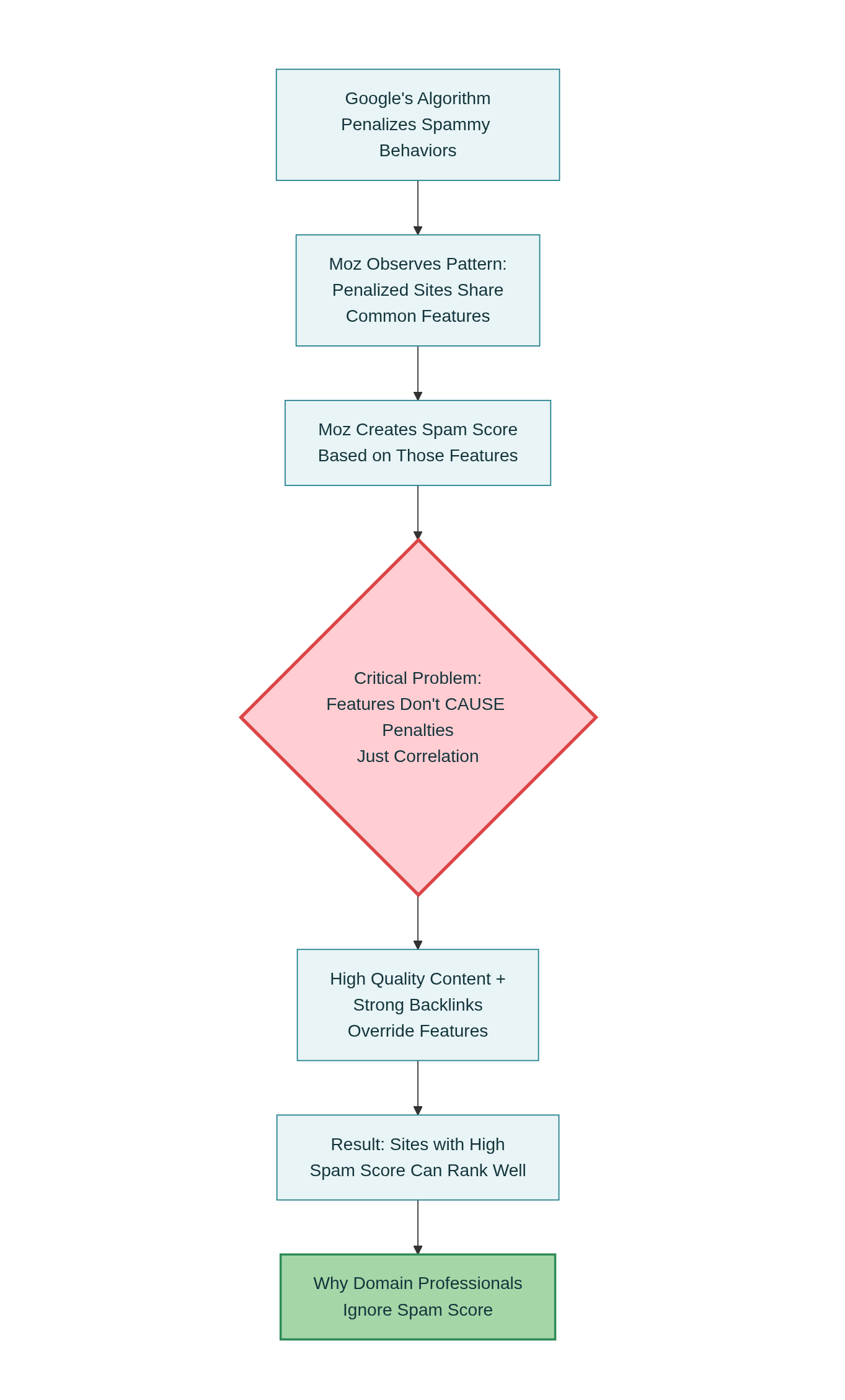
The most critical issue with Moz spam score is that it represents correlation, not causation. Moz developed this metric by analyzing a set of common features found on websites that Google has penalized or banned[1][5]. However, the mere presence of these features does not cause Google penalties; rather, these features were observed after penalization. This critical distinction explains why the metric fails as a predictor of actual ranking performance.
In broader SEO research, analysts repeatedly emphasize that correlation does not equal causation: just because two signals appear together in penalized sites does not mean that manipulating those signals directly will lead to or prevent penalties. Confusing correlation with causation leads to misguided strategies, and Moz spam score is a textbook case of this problem. It measures the presence of traits that tend to appear on penalized sites, but it does not measure the underlying behaviors that actually trigger Google’s actions[21].
Even Moz itself acknowledges this limitation in its own documentation. Moz explicitly notes that a high spam score does not mean that a site is definitively spammy and clarifies that the metric is based on patterns observed in sites that were penalized, not on any direct, confirmed cause–effect relationship with Google’s algorithm[16]. In other words, Moz positions spam score as a heuristic warning signal, not as a direct ranking factor and not as a reliable predictor of future performance. Google, for its part, does not use Moz spam score in any way inside its ranking systems[1][4].
What Aged Domain Professionals Actually Evaluate: Real Spam Signals
Professional domain investors and aged domain specialists focus on genuine warning signs in the backlink profile—the actual harmful patterns that Google is known to penalize. Rather than taking abstract third‑party metrics at face value, they dig into the data and manually inspect the backlink profile. Two categories of signals stand out as central in this process: over-optimized anchor text and toxic niche anchors.
Over-Optimized Anchor Text: The Critical Red Flag
When aged domain professionals evaluate a domain’s backlink profile, anchor text distribution is one of the most important factors they examine. However, they are not simply glancing at a single score or percentage; they are looking at specific patterns that map directly to known link manipulation strategies.
First, they examine exact-match anchor text. Exact-match anchor text is when the clickable text of a backlink is precisely the target keyword or key phrase[62]. In natural link acquisition, exact-match anchors tend to be a small minority of the total profile because most organic links use branded, URL, or generic anchors. When exact-match keywords start to dominate—often beyond roughly 5–10% of the profile—this suggests deliberate manipulation rather than organic linking behavior[60][62].
Second, professionals look at the overall distribution of anchor types. A healthy profile usually includes a mix of branded anchors, generic/natural anchors (like “click here” or the naked URL), partial-match anchors, and a relatively small portion of exact-match anchors[71]. Aged domain practitioners are particularly wary when they see profiles where commercial, keyword-rich anchors form a large share of the total, especially if the brand name is underrepresented. Such distributions are atypical of natural linking and often indicate past aggressive SEO campaigns[71].
Third, they look for commercial keyword stuffing in anchors. Anchors that repeatedly include hard-sell phrases, price terms, or other heavily monetized language (for example, “buy cheap X,” “best online casino,” or similar) signal attempts to use anchor text for ranking manipulation rather than as a neutral descriptive label[60][65]. This pattern, combined with a high frequency of exact-match anchors, is one of the strongest practical signals that a domain’s link profile has been pushed beyond what would occur naturally.
Toxic Niche Anchors: Immediate Deal-Breakers
Aged domain professionals also pay extremely close attention to toxic niche anchors. These are anchor texts that belong to industries or niches that Google tends to associate with aggressive and often manipulative SEO practices, such as adult content, gambling and casinos, pharmaceuticals, and payday loans.
When a domain’s backlink profile contains anchor texts with adult, gambling, or similar high-risk terms, this suggests that the domain was either directly used in those industries or was involved in link schemes targeted at them[72]. For example, it is common to find hacked sites or expired domains that have been repurposed to host links pointing to casino or adult properties. When evaluating an aged domain for use in a different niche (such as health, finance, or SaaS), professionals usually treat a strong presence of these anchors as a serious red flag.
Importantly, practitioners differentiate between isolated anomalies and systemic contamination. A single random adult or casino link among hundreds of clean, topically consistent links may not be cause to discard a domain outright; it might be the result of historical scraping or automated spam that Google already ignores[69]. However, if a large fraction of the anchor text profile is made up of adult, casino, or other toxic niche anchors, most serious aged domain buyers will consider the domain compromised and unsuitable for reuse in a clean project.
This focus on toxic anchors reflects a simple principle: the context of linking domains matters. Links from sites in spammy or high‑risk verticals can be a signal that the domain was part of link schemes, hacked networks, or other problematic patterns[63]. These are genuine risk factors that can lead to algorithmic devaluation or make it harder to build a clean, sustainable SEO asset on that domain.
What Domain Professionals Actually Evaluate Beyond Anchors
While over-optimized and toxic anchor text represent the most concrete and immediate spam signals, aged domain experts do not stop there. A thorough vetting process also includes several other layers of analysis that align much more closely with how Google is believed to evaluate sites than anything derived from Moz spam score.
First, professionals consider the relevance of linking domains. They assess whether the sites linking to the domain are thematically related to the domain’s intended niche or at least within reasonable topical proximity[63]. A backlink from a reputable site in a closely related industry is far more valuable than a link from an unrelated blog network. Conversely, if many of the links come from sites that have no thematic connection, this can signal past manipulative campaigns or paid link activity.
Second, they analyze link acquisition patterns over time. Natural link growth tends to be somewhat gradual and noisy but rarely exhibits sharp, unexplained spikes followed by long plateaus[70]. Sudden bursts of hundreds or thousands of links over a short period, particularly from low-quality or irrelevant sites, are classic indicators of automated link building or purchased link packages. Aged domain evaluators use historical link graphs and archived snapshots to identify whether a domain’s link growth reflected organic interest or artificial manipulation.
Third, they review the domain’s historical usage and content using tools like the Wayback Machine[75]. This step helps determine whether the domain has been used as a legitimate website, a Private Blog Network (PBN), a doorway site, or something more malicious. A domain that spent years as a real business or content site and only later expired is far more attractive than a domain that was repeatedly repurposed as a thin affiliate page or a PBN node linking out to multiple niches.
Finally, professionals check indexation and current visibility. A domain that is completely deindexed or has a long history of indexing problems may carry algorithmic baggage, even if its visible backlink profile looks acceptable. Conversely, a domain that still has pages indexed, or whose content has historically driven organic traffic, often presents a better starting point for a new project[15].
Why Moz Spam Score Fails as a Vetting Tool
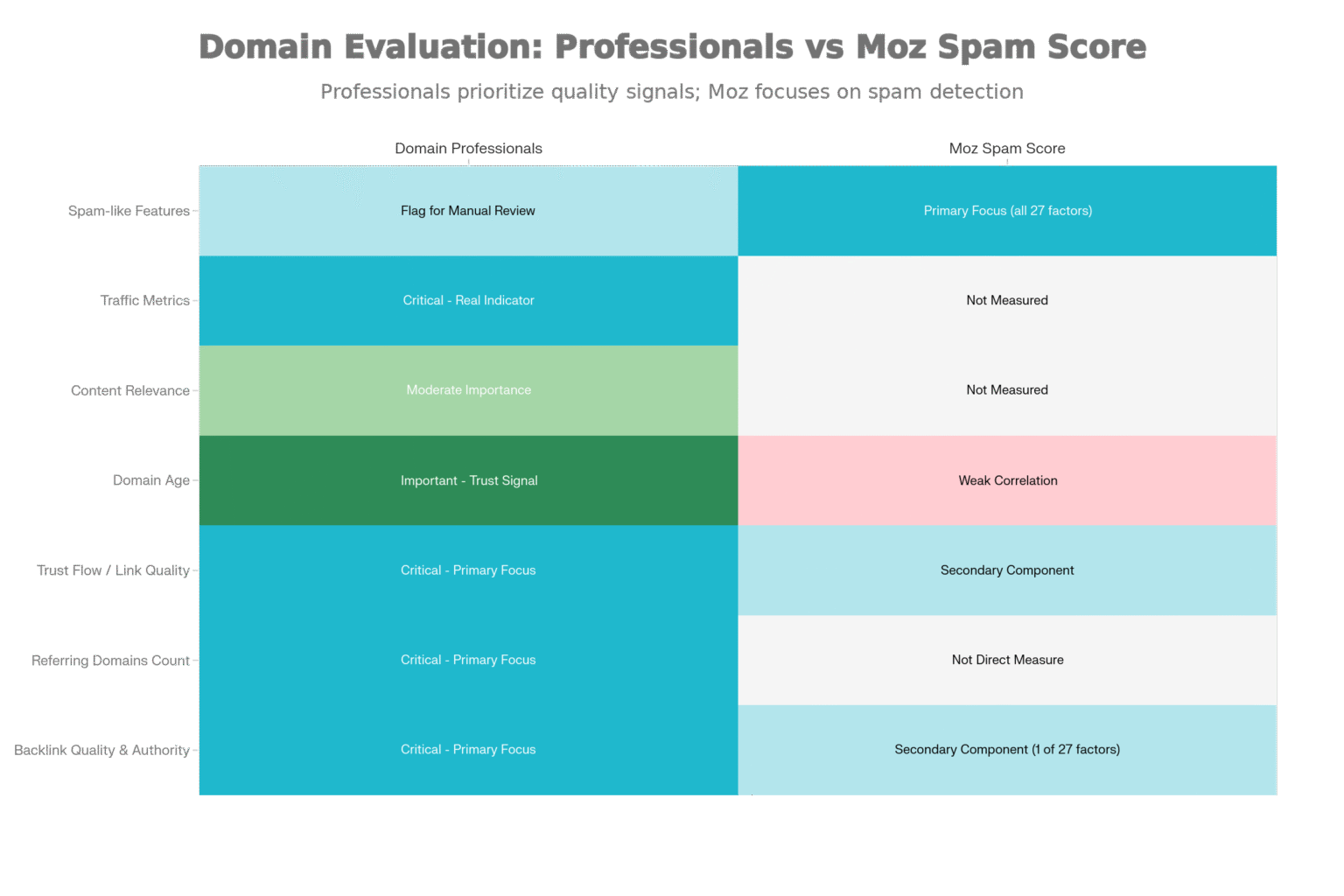
The practical shortcomings of Moz spam score become obvious when you compare what it measures with what aged domain professionals actually need to know.
First, it measures correlation instead of real harm. Spam score identifies sites that share certain statistical characteristics with penalized domains, but it does not measure actual violations of Google’s guidelines[1]. As a result, a domain can have a high spam score simply because it resembles patterns seen in some penalized datasets, while still performing well and being perfectly usable in practice.
Second, it lacks actionable granularity. A single spam score percentage does not tell you whether the perceived risk arises from anchor text manipulation, toxic niches, unnatural link velocity, or other issues[71]. By contrast, manual anchor text analysis immediately reveals where the real problems lie—whether a domain is suffering from exact-match stuffing, casino anchors, or other clearly identifiable patterns. This difference in diagnostic precision is crucial for professionals making buy/no-buy decisions.
Third, it is a third‑party metric not used by Google. Google has repeatedly stated that it does not use third‑party authority or spam metrics in its ranking systems[31]. Moz spam score is, by design, a tool-side heuristic. From the perspective of aged domain investors, anchoring decisions to a metric that Google itself ignores makes little sense when they can directly inspect the signals that Google is known to care about, such as link relevance and anchor text naturalness.
Fourth, it can be artificially influenced. Research comparing manipulation resistance across SEO tools found that Moz’s Domain Authority and Spam Score are among the most easily influenced metrics through artificial link-building[28]. That makes it unreliable as an objective measure of domain health. In contrast, assessing the actual distribution of anchors, the topical match of linking sites, and the historical use of the domain is much harder to fake and far more aligned with Google’s own evaluation processes.
The Industry Consensus: Focus on Real Signals, Not Tool Scores
Discussions among experienced SEOs and aged domain practitioners show a consistent pattern: Moz spam score is widely regarded as, at best, a soft heuristic and, at worst, a distraction. Professionals frequently point out that it is a proprietary construct created by a tool vendor, not a standard recognized by search engines or serious investors[25][10][22]. Many also note that focusing too heavily on spam score can lead newcomers to discard perfectly good domains or, conversely, to feel overly secure about domains that look fine in Moz but have deeper issues visible upon manual inspection.
By contrast, there is strong and practical consensus around the importance of anchor text analysis and domain history. Almost every serious guide to using aged or expired domains emphasizes the need to check for over-optimized anchors, toxic niche terms, and evidence of past abuse[15][60][71][75]. This is because these elements map directly to real-world risks: they correspond to how Google detects link schemes, doorway sites, and hacked or repurposed domains, all of which can impact the future performance of a site built on that domain.
In day‑to‑day practice, aged domain buyers treat Moz spam score as, at most, a very rough “smoke detector”: if a score is extremely high, it may prompt a closer look, but any decision is ultimately based on the underlying link data, not the number itself. Many experienced practitioners simply ignore spam score entirely and rely instead on manual backlink audits, their own heuristics, and a combination of tools that expose raw linking and anchor data rather than derived summary scores[7].
This practical behavior within the industry aligns logically with the nature of the metric. Since spam score is a correlation model built on limited training data, and since it is not part of Google’s internal ranking signals, relying on it for high-stakes decisions like domain acquisition is hard to justify. Evaluating the tangible, verifiable characteristics of a domain’s link graph and history is far more robust and has a clearer connection to real ranking outcomes.
Why Strong Backlink Profiles Override Moz Spam Score
The reason domains with high Moz spam scores can and do perform well in search results comes down to one core fact: Google ultimately ranks pages and domains based on the quality and relevance of their content and links, not on third‑party scores[27][32][45]. If a domain has a strong, contextually relevant backlink profile with natural anchors and a clean usage history, these real ranking signals will dominate regardless of what Moz’s model predicts.
In practice, this means that a domain might carry a high spam score because it happens to share some superficial traits with penalized sites in Moz’s dataset, yet still be an excellent candidate for a new project. For example, an older domain in a competitive vertical may have accumulated many commercial anchors and a wide variety of referring domains, some of which Moz’s model interprets as risky. However, if those anchors are reasonably distributed, not dominated by toxic niches, and the domain’s historical content and usage have been legitimate, Google may treat the site as trustworthy and its link equity as valuable.
This dynamic illustrates again the difference between predicting risk based on statistical patterns and evaluating actual link quality. Aged domain specialists trust what they see in the backlink and anchor data more than what any single spam metric suggests. They favor domains whose link profiles make sense for their intended use—where the majority of anchors are branded or natural, where toxic niche anchors are absent or minimal, and where linking domains are relevant or at least normal for the topic.
Ultimately, strong backlink profiles with natural anchor text patterns, topical relevance, and clean historical usage are what allow domains to rank and perform. Moz spam score is not part of Google’s decision-making process, so a high or low score by itself has no direct bearing on rankings. It can sometimes point to issues worth investigating, but it is neither necessary nor sufficient as an indicator of domain quality.
The Final Takeaway
For SEO professionals and aged domain investors, the implications are straightforward. Moz spam score is a proprietary correlation metric that is not used by Google and provides limited actionable insight when compared to direct analysis of a domain’s backlink profile[4][7]. The practitioners who operate successfully in the aged domain space consistently prioritize real, inspectable signals such as anchor text distribution, the presence of toxic niche anchors, domain history, and link relevance[57][71][75].
By focusing on these concrete indicators—rather than on abstract tool-side scores—professionals align their evaluation process with the actual mechanics of Google’s ranking systems. Over-optimized anchor text and toxic niche anchors are genuine red flags that map to known spam patterns and can meaningfully affect performance. In contrast, Moz spam score is, at best, an indirect heuristic and, at worst, a distraction that can lead to poor decision-making if treated as a primary criterion.
The most robust path for evaluating aged domains therefore involves setting Moz spam score aside and instead conducting a careful manual audit of backlinks and anchors: checking for over-optimization, identifying and weighing any toxic niche anchors, verifying historical usage, and confirming topical and contextual relevance of the link graph. These practices, rather than reliance on Moz spam score, are what give aged domain experts confidence that a domain can be safely and effectively used to build organic search performance.